

🏏 Predict & Win Gaming Zone
Follow:
Rare Blue Octopus Species Discovered in Deep Waters Near Galapagos Islands
Business & Economy May 26, 2026 Default Admin

Rare Blue Octopus Species Discovered in Deep Waters Near Galapagos Islands

Scientists have identified a rare new blue octopus species near the Galapagos Islands, revealing fascinating insights into deep-sea biodiversity, marine evolution, and unexplored ocean ecosystems.

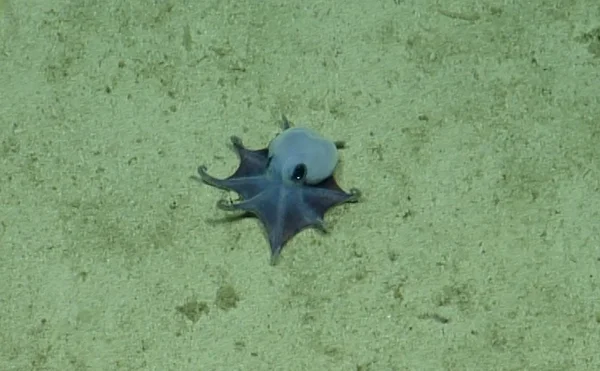
Scientists have discovered a fascinating new species of blue octopus deep beneath the Pacific Ocean near the Galapagos Islands, adding another remarkable finding to the mysteries of the deep sea.


The newly identified species, officially named Microeledone galapagoensis, was discovered at a depth of around 1,800 meters below sea level near Darwin Island in the Galapagos region.


Researchers say the tiny marine creature immediately stood out because of its unusual bright blue coloration and unique physical characteristics rarely seen in known octopus species.

Discovery Captured During Deep-Sea Exploration

The octopus was first observed during a scientific deep-sea expedition using a remotely operated underwater vehicle.


Scientists monitoring the footage became excited when the tiny blue creature appeared on screen, with one researcher reportedly shouting, “There it is! It’s blue!”


The small octopus, described as being roughly the size of a golf ball, quickly attracted global scientific attention because of its rare appearance and mysterious origin.

Scientists Amazed by Unique Appearance

The research was conducted by a team associated with the Charles Darwin Foundation and later published in the prestigious scientific journal Zoologica.


Octopus expert Janet Voight explained that she immediately recognized the species as something extraordinary after first seeing images of the animal.


According to researchers, the octopus has several unusual characteristics including:

  • Short and stubborn arms
  • A single row of suckers on each arm
  • Smooth skin texture
  • Distinctive blue and purple body coloration

These features separate it from most previously documented octopus species.

Advanced Technology Used Instead of Dissection

Normally, scientists studying a newly discovered octopus species examine internal body structures by dissecting specimens.


However, researchers had only one preserved sample of this rare species and wanted to avoid damaging it.


Instead, scientists at the Field Museum of Natural History used advanced CT scanning technology to create thousands of X-ray images and develop a highly detailed three-dimensional model of the octopus.


This innovative process allowed researchers to study the creature’s internal anatomy without harming the specimen.

Strange Color Pattern May Help Survival

One of the most fascinating features of Microeledone galapagoensis is its unusual color pattern.


Researchers noted that the upper side of the octopus appears light blue, while the lower side is a deep dark purple.


Scientists believe this coloration may serve as a defense mechanism in the deep sea.


According to researchers, if prey emits light in the dark ocean environment, the octopus may use its darker underside to conceal the glow and avoid attracting larger predators.

Evolutionary Mystery Raises Questions

Scientists were also surprised because the species appears related to octopuses found near Antarctica and South America, despite being discovered in a very different marine environment.


Its closest known relative reportedly lives near the coast of Uruguay, prompting new questions about deep-sea migration, evolution, and species distribution across the Pacific Ocean.

Deep Oceans Still Full of Mysteries

Marine experts say the discovery highlights how little humanity still knows about Earth’s deep oceans.


Large areas of the Pacific Ocean remain unexplored, and scientists believe many unknown marine species are yet to be discovered.


Janet Voight emphasized that even combining all of Earth’s landmass would not completely cover the vast Pacific Ocean, illustrating how enormous and mysterious the deep sea truly remains.

Connection to Charles Darwin’s Legacy

The octopus was first spotted near Darwin Island, a location named after Charles Darwin, whose studies in the Galapagos Islands played a crucial role in developing the theory of evolution.


Researchers believe discoveries like this continue to strengthen the scientific importance of the Galapagos region for understanding biodiversity and evolution.


The discovery of Microeledone galapagoensis represents another major breakthrough in marine biology and deep-sea exploration.


With its striking blue color, unusual anatomy, and mysterious evolutionary background, the tiny octopus is already capturing the attention of scientists worldwide and reminding humanity that the ocean still holds countless secrets waiting to be uncovered.

React to this post