
Predict & Win Gaming Zone
Follow:
How AI Is Replacing Everyday Jobs: The Silent Job Shift
Technology June 22, 2026 Anup Kasula

How AI Is Replacing Everyday Jobs: The Silent Job Shift

AI replacing everyday jobs is no longer a prediction—it’s happening in real time across industries. From customer service to content creation, artificial intelligence is quietly reshaping how we work. This article explores which jobs are most affected, what skills matter now, and how you can prepare for the future.

AI Replacing Everyday Jobs: The Silent Job Shift

The debate on artificial intelligence taking over people’s everyday jobs is now happening in offices, in factories, at hospitals, and even in places where creativity happens. Artificial intelligence is not coming in the future; rather, it is present now and changing the way we do work without anyone’s notice.

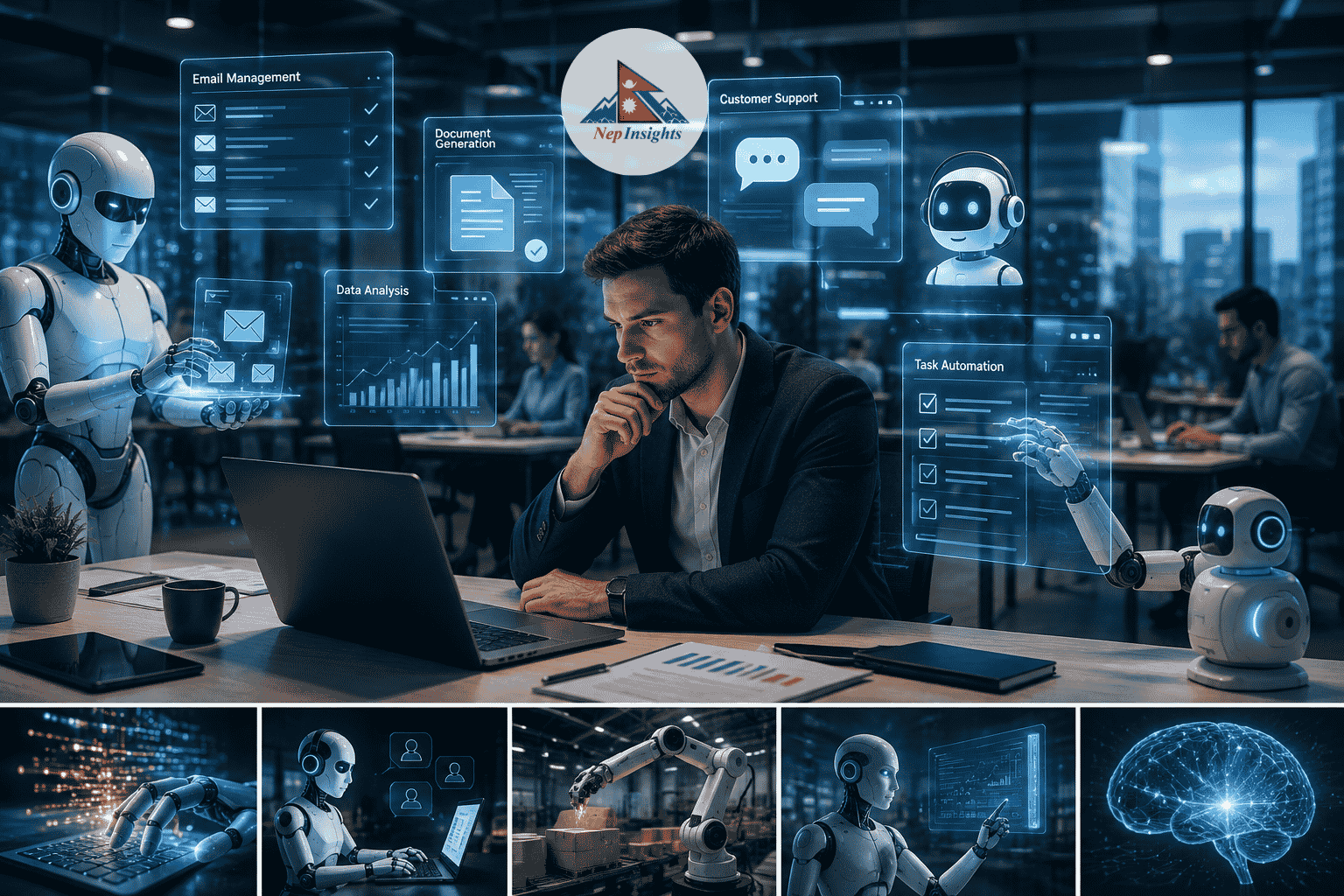
Automation of tasks was limited only to those involving repetition in the last ten years. However, now, artificial intelligence is writing emails, analyzing data, designing graphics, answering customers’ inquiries, and writing legal documents too.

That which makes this change more interesting is its very discreet nature, whereby unlike previous revolutions, which could easily be witnessed in terms of manual work being done, AI replacing daily work takes place through dashboards and systems.

And that raises an important question: what happens next?

The Rise of AI in Everyday Work

Artificial intelligence is no longer confined to tech companies or research labs. It is now part of mainstream business operations.

From scheduling meetings to detecting fraud in banking systems, AI is quietly taking over tasks that once required human intervention. This transition is not always about full job replacement, it often starts with partial automation.

For example:

  • A marketing assistant may now rely on AI tools to draft campaigns
  • Customer service teams use chatbots for first-level support
  • Accountants use AI software to categorize transactions
  • Recruiters use AI to screen resumes faster

Each of these shifts contributes to the broader trend of AI replacing everyday jobs, even if the full role doesn’t disappear immediately.

Jobs Most Affected by AI Automation

Not all jobs are impacted equally. Roles that involve repetitive, rule-based, or data-heavy tasks are the most vulnerable.

1. Administrative and Clerical Jobs

Data entry, scheduling, and document processing are increasingly handled by automation tools.

2. Customer Support Roles

AI chatbots and voice assistants can resolve a large percentage of common queries without human agents.

3. Retail and Cash Handling

Self-checkout systems and automated payment solutions reduce the need for cashiers.

4. Content Generation Tasks

Basic copywriting, product descriptions, and reports are now often generated using AI writing tools.

5. Data Analysis Roles

AI systems can process large datasets and generate insights faster than traditional manual analysis.

While these jobs may not disappear entirely, their structure is changing rapidly due to AI replacing everyday jobs across multiple industries.

How AI Is Changing, Not Just Replacing Jobs

A common misconception is that AI only destroys jobs. In reality, it often transforms them.

Instead of eliminating entire professions, AI tends to:

  • Automate repetitive parts of a job
  • Increase productivity
  • Shift human focus toward decision-making and creativity

For instance, doctors now use AI-assisted diagnostics, but they still make final medical decisions. Similarly, writers may use AI tools to brainstorm ideas but still craft the final narrative themselves.

This hybrid model suggests that AI replacing everyday jobs is not just about loss it is also about evolution.

The Hidden Speed of Workplace Transformation

One of the most underestimated aspects of AI adoption is speed.

Unlike previous technological shifts that took decades, AI tools can be adopted almost instantly. A company can integrate AI-powered customer support overnight. A marketing team can switch to AI-generated content tools within days.

This rapid adoption creates a gap:

  • Businesses move quickly
  • Workers adapt more slowly
  • Education systems lag behind

This mismatch is one reason why concerns about AI replacing everyday jobs are growing globally.

Skills That Matter in an AI-Driven World

As automation increases, certain skills become more valuable—not less.

1. Critical Thinking

AI can generate answers, but humans must evaluate accuracy and relevance.

2. Creativity

Original ideas, storytelling, and innovation remain difficult for AI to fully replicate.

3. Emotional Intelligence

Roles requiring empathy, communication, and human understanding remain essential.

4. Digital Literacy

Understanding how AI tools work is becoming a baseline requirement in most industries.

5. Adaptability

The ability to learn new tools and workflows quickly is now a key career advantage.

Instead of competing with AI, successful professionals learn how to collaborate with it.

Industries Being Transformed First

Some industries are experiencing AI disruption faster than others:

Healthcare

AI assists in diagnostics, patient monitoring, and medical imaging.

Finance

Fraud detection, algorithmic trading, and credit scoring rely heavily on AI.

Media and Content

Automated journalism and AI-generated content are increasingly common.

Transportation

Self-driving technology and logistics automation are reshaping supply chains.

Each of these sectors demonstrates how AI replacing everyday jobs is not uniform it varies by industry maturity and data availability.

The Psychological Impact of AI on Workers

Beyond economics, AI transformation has a psychological dimension.

Many workers feel uncertainty about:

  • Job stability
  • Skill relevance
  • Long-term career paths

This uncertainty can lead to stress, but it also drives upskilling trends. Online learning platforms and corporate training programs are growing as people try to stay relevant in an AI-influenced economy.

Understanding that AI replacing everyday jobs is gradual not instantaneous can help reduce fear and encourage proactive learning.

Will AI Completely Replace Human Jobs?

Despite rapid advancements, full replacement of human labor across all sectors is unlikely in the near future.

Why?

  • Humans are still better at complex judgment
  • Ethical decision-making requires human accountability
  • Emotional and social interaction remains difficult for machines
  • Many jobs require physical adaptability in unpredictable environments

Instead, the more realistic outcome is job redesign, not total elimination.

Internal Linking Suggestions

To improve SEO structure, this article can internally link to:

  • Future of Work Trends in 2030
  • Top Skills to Learn for AI Careers
  • How Automation Is Changing Remote Jobs
  • Best AI Tools for Productivity in 2026

External Authoritative References (Suggested)

  • World Economic Forum reports on future of jobs
  • OECD studies on automation and employment
  • Stanford AI Index reports

These sources provide credibility and strengthen E-E-A-T signals.

FAQ Section

1. Is AI really replacing everyday jobs?

Yes, AI is gradually automating parts of many jobs, especially repetitive and data-driven tasks.

2. Which jobs are most at risk from AI?

Administrative roles, customer support, data entry, and basic content creation are most affected.

3. Will AI completely replace human workers?

Not entirely. Most jobs will be transformed rather than fully eliminated.

4. What skills are important in the AI era?

Critical thinking, creativity, emotional intelligence, and digital literacy are key.

5. How fast is AI changing the job market?

The change is rapid, with some industries adopting AI tools within months.

6. Can learning AI tools help my career?

Yes, understanding AI tools can significantly improve productivity and job opportunities.

7. Is AI more of a threat or opportunity?

It is both. It removes some tasks but also creates new roles and industries.

8. What should students do to prepare for AI jobs?

Focus on adaptable skills, learn technology basics, and stay updated with emerging tools.

Conclusion

The rise of AI replacing everyday jobs is reshaping the global workforce in ways that are both disruptive and transformative. While some roles are shrinking, new opportunities are emerging that require different skills and thinking patterns.

The future of work will not be defined by humans versus AI, but by humans working alongside AI systems. Those who adapt, learn, and evolve with these changes will find themselves better positioned in the new economy.

The shift is already underway understanding it early is the real advantage.

If you want to stay ahead of these changes, explore more insights on future skills, AI tools, and workplace transformation strategies.

React to this post