

Related Articles






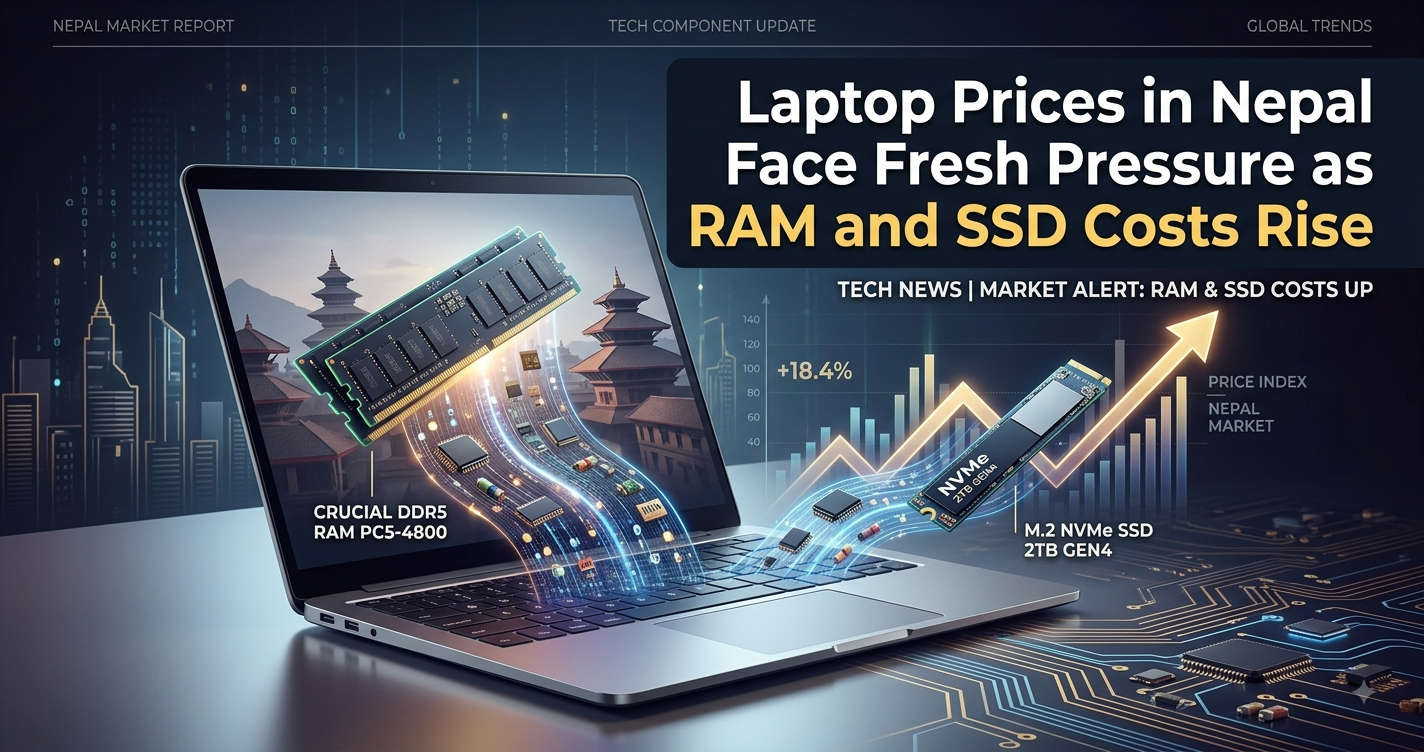
Laptop Prices in Nepal Face Fresh Pressure as RAM and SSD Costs Rise
If you've seen computer hardware lately, you've likely noticed RAM and SSDs are no longer as inexpensive as ever.
This is a regional problem that is not isolated. The memory industry is facing several challenges globally, and even more complicated with the fast growth of the AI infrastructure.
In the third quarter of 2026, conventional DRAM contract prices will rise by 13% to 18%, according to TrendForce. The technology used by the majority of SSDs – NAND Flash – is also likely to see 10%-15% price hikes in the same timeframe.
Not all laptops in Nepal will all of a sudden increase their prices by 15% due to this. There are a lot of other factors which influence laptop pricing such as processor prices, graphics cards, exchange rates, shipping, taxes, distributor margins and existing stocks.
However, memory has become yet another expense that manufacturers are not able to afford to overlook.
AI Is Changing the Memory Market
The interesting thing about this situation is that ordinary laptop buyers are not necessarily responsible for the increased demand.
AI data centers are.
AI systems require vast amounts of memory for modern use. The companies developing and deploying such systems are purchasing fast memory and storage at speeds and sizes that the PC market can't keep up.
Memory makers are meeting the demand and the impact is being felt throughout the entire industry.
TrendForce estimates that demand for AI will continue to be the main force behind memory's growth into 2027, and that DRAM supply will remain constrained. The NAND market could behave somewhat differently, but demand from AI infrastructure is still an important factor.
This is one way that this situation of memory is different than a normal short term price change.
Why RAM and SSD Prices Matter for Laptops
When discussing the price of a laptop, you can easily forget about RAM and SSDs.
When comparing laptops, most users compare them based on the processor or graphics card. However, no matter what type of laptop you are using, there will still be a need for memory and storage, and the more you want in the more expensive the laptop.
A basic laptop can come with 8GB RAM and a 256GB or 512GB solid-state drive (SSD).
The 16GB or 32GB of RAM and 1TB SSD are standard features of a gaming laptop or workstation.
When those parts go up, manufacturers are in two situations; they must either cover the additional expense or, over time, they must charge consumers more for the product.
Both are not very appealing in this very competitive PC market.
Nepal Could Feel the Increase Later
The situation in Nepal is slightly different from larger markets because most laptops sold here are imported.
That means a change in global component prices does not necessarily appear immediately in local shops.
A distributor could have bought a stock of memory months ago at a different price. Those machines will remain on sale at the original price until they are out of stock.
The next shipment will be more expensive, though.
When consumers might begin to notice any difference in laptop pricing in Nepal, it will be during this time.
It also provides a clue as to the reasons for sometimes seeing the prices of two similar laptops vary so much. One stock may be older and the other may be new and have a different cost structure.
Therefore, if prices increase, it's likely not to happen quickly in the entire laptop market.
Gaming Laptops May Feel It More
Gaming laptops are a special case in that they will require more memory and storage than a normal laptop for a similar price.
These days, a gaming laptop will probably be equipped with 16GB of RAM and at least 512GB of SSD storage. The higher-powered models tend to go up to 32GB of RAM and a 1TB of storage.
This puts them at greater risk of memory costs.
This is the same for laptops designed for video editors, designers, developers and more, where more RAM and storage are required.
Of course, it doesn't imply that anything with RAM or SDD will inevitably be costly. It's just too many other factors.
However, as manufacturers are working to fit a laptop into a specific price range, increased memory costs can make some tough decisions.
The company can either raise the price, cut down a specification, or lower the margin.
Should You Buy a Laptop Now?
Most of the people are probably wondering this.
Personally, I wouldn't recommend rushing out to buy a laptop simply because memory prices are increasing.
But do not delay buying what you need because you think they will drop in price.
It's impossible to forecast a laptop's cost six months in the future.
If you're in college and need a laptop, or for work, programming, designing or gaming and have found a laptop that has nice features for a reasonable price, there's nothing wrong with buying it now.
The key takeaway is that the real machine is the one that matters, not the notion that all laptops are going to cost a lot more.
Look at Upgradeability Before Paying More
Another factor to keep in mind when purchasing a laptop at a time when memory is expensive is upgradeability.
If a laptop is available with a removable slot for RAM, it may be a better idea to do a smaller configuration and upgrade it in the future.
This is true when it comes to storage too. For users who may require more storage in the future, a laptop that comes with an NVMe SSD that can be upgraded is a great option.
As you know, this is subject to the model. Some thin and light laptops now come with soldered memory which may result in no RAM upgrade.
That's why I might want to look at upgrade possibilities before purchasing, since I wouldn't want to assume that all laptops can be upgraded.
Sometimes a lower-priced laptop that is easier to upgrade is a better deal than a machine with more expensive specs for a dedicated user who can't afford a costly upgrade.
What This Means for Laptop Buyers in Nepal
For Nepalis, the most realistic forecast is that the price of laptops might be kept under pressure instead of skyrocketing.
There may be models that get even higher. Some others may remain where they are as retailers might still have older stock around, or manufacturers might be absorbing some of the extra cost.
As new stock becomes available, the difference will become apparent.
When buying a laptop when you are in the market, the prices of one laptop model will be compared with the prices of other laptop models and the complete specification will be taken into consideration. If you don't need more RAM or storage then don't pay for it.
Don't opt for an unnecessarily weak configuration, however, in order to save a little now.
A 16GB RAM and a 512GB SSD is a good starting point for most users and it may be more than enough for heavy usage, but for heavier users 32GB RAM and a 1 TB SSD is a better option.
React to this post
Related Articles