

Related Articles






Europe Faces Its Worst Wildfire Crisis in Decades
Wildfires are tearing through southwestern France and central Spain, turning thousands of hectares of forest to ash. More than 300,000 people across both countries have been forced from their homes.
Extreme heat, months of drought, and shifting winds have pushed the fires beyond control. Meteorologists warn temperatures will climb again this week, with no rain in sight.
France's Largest Peacetime Evacuation Since WWII
The worst of the crisis is unfolding in France's Gironde region, where fire is advancing toward the wine city of Bordeaux. Authorities have carried out the country's biggest peacetime evacuation since World War II.
Around 220,000 people have been evacuated in France so far, with new orders issued overnight for towns near Bordeaux. Thousands are sheltering at a converted exhibition center in the city itself.
Bordeaux's metropolitan area, home to roughly one million people, has not been directly hit. But nearby towns have emptied out completely. Le Porge, a community of 3,500 people west of the city, has been especially hard-hit.
Fire Crews, Soldiers, and Military Aircraft Deployed
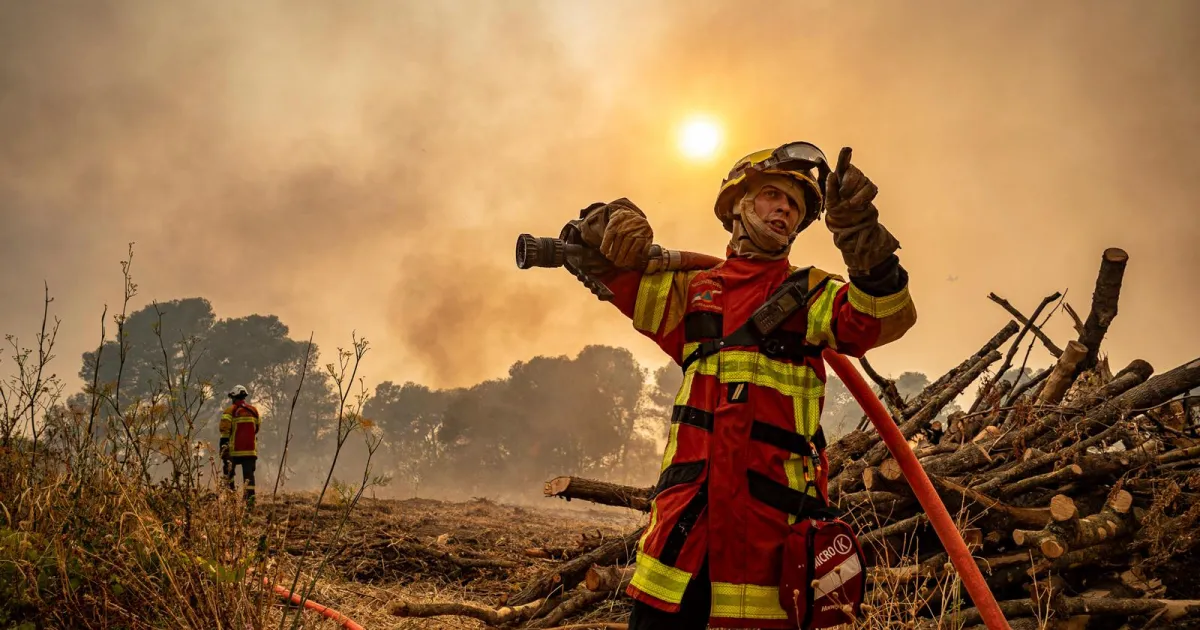
France has thrown a massive response at the fire: around 1,400 firefighters in the Gironde region alone, backed by soldiers, police, and gendarmes. A military A400M transport plane has been converted to drop flame retardant, joining at least 18 other water- and retardant-dropping aircraft.
The fire's unpredictability is part of what makes it so dangerous. French Interior Minister Laurent Nuñez said the blaze has become "extremely virulent," generating its own wind and shifting direction erratically toward Bordeaux.
The disruption has reached far beyond the fire line. A major highway toward Spain has closed, flights out of Bordeaux have been delayed or cancelled, and organizers shortened the final stage of the Tour de France to free up security personnel for firefighting duty.
Spain's Battle in Madrid and Ávila
Spain is facing its own crisis. More than 75,000 people have been evacuated and another 30,000 ordered to shelter in place across the Madrid, Ávila, and Toledo regions.
Flames in Ávila have burned over 50,000 hectares, making it one of the largest wildfires in Spain's recent history, according to the country's environment ministry. At least one death has been confirmed, in the municipality of Manises.
Spanish Prime Minister Pedro Sánchez visited the affected areas and said Sunday night brought some progress in controlling the flames, but cautioned that "difficult hours" remain ahead.
Voices From the Evacuation Zones
For residents, the damage is personal. Evacuees returning briefly to collect medicine or belongings describe scenes of ash-covered streets and unrecognizable landscapes.
One evacuee near Madrid, who fled with her dog, said the area looked like "the apocalypse" everything covered in ash, nothing visible through the smoke.
Firefighters say they've rarely seen conditions like this. Crews in Spain reported the fires spreading too fast and violently to be fought head-on, while in France some residents escaped burning coastal towns by boat.
Why This Fire Is So Hard to Control
Fire commanders say the blazes are behaving unlike anything they've fought before. The scale of the heat is generating its own wind patterns and vortexes, causing the fire's direction to shift by the hour forcing crews to constantly rework their strategy.
Local volunteers have stepped in to support exhausted firefighting crews, organizing food, rest stops, and supplies in the hardest-hit communities.
What's Driving the Crisis
Scientists and officials point to a combination of factors pushing this year's fires beyond normal severity:
- Extreme, prolonged heat across southwestern Europe
- Long-term drought that has dried out vegetation and soil
- Shifting, unpredictable winds that make containment difficult
- No rain forecast for the affected regions in the days ahead
Officials in both countries have linked the severity directly to climate change, describing this year's fire behavior as a preview of what may become a regular seasonal risk.
What Happens Next
Forecasters expect temperatures to rise again this week after a brief dip over the weekend, with no rain expected. Officials say the next few days will be critical in determining whether the fires can be brought under control before conditions worsen further.
Evacuated residents in both countries have been told they won't be allowed to return home until the fires are fully contained. For now, the focus remains on containment and safety with recovery and rebuilding expected to take months.
React to this post
Related Articles






.jpg)