

Related Articles









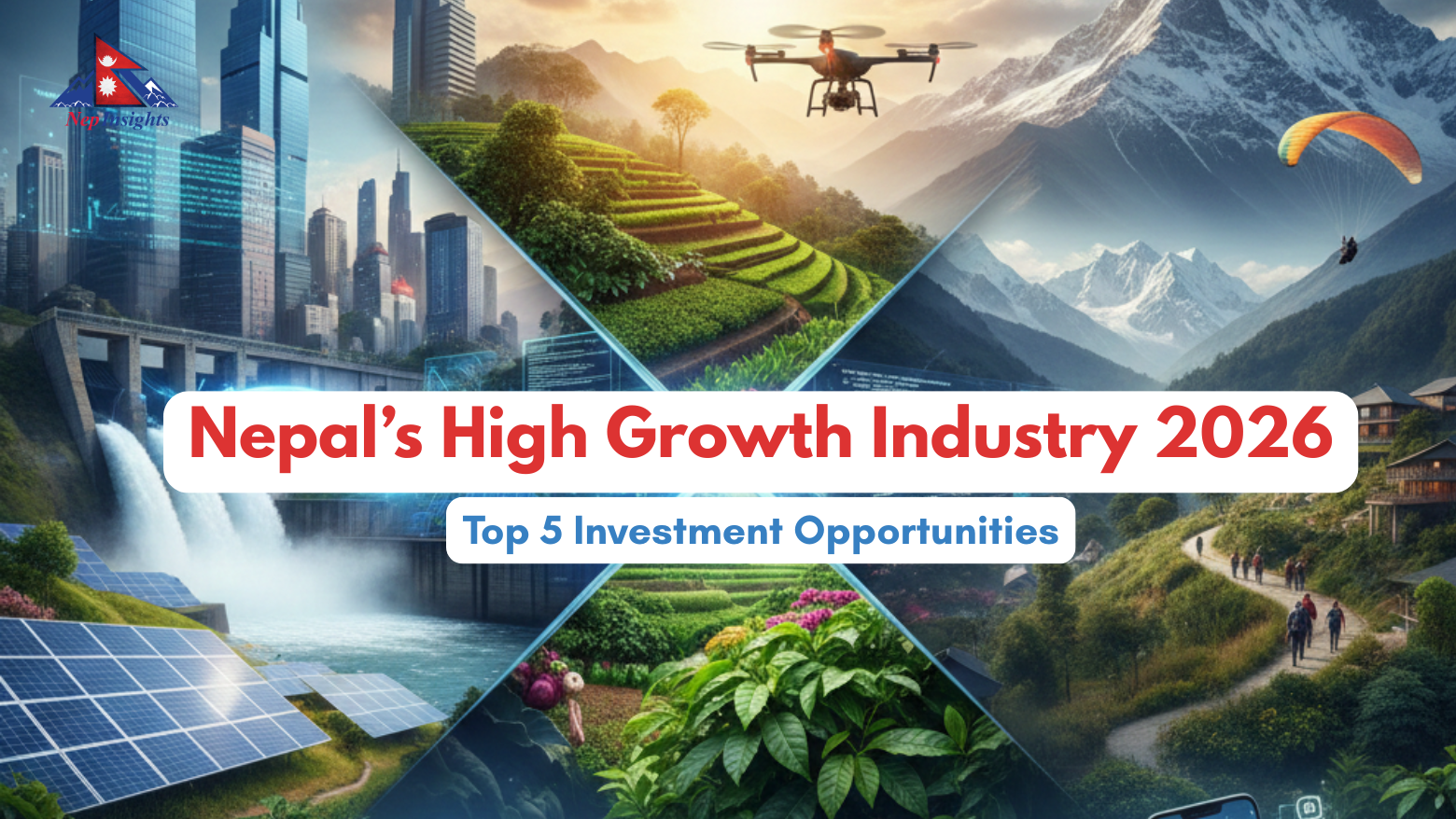
Top 5 High Growth Industries in Nepal 2026: Best Investment & Business Opportunities | Nepinsights
Top 5 High Growth Industries in Nepal for 2026: Best Business & Investment Opportunities
Nepal’s economy is entering a high-growth, opportunity-driven phase in 2026, making it an exciting time for investors, entrepreneurs, and job seekers. Unlike previous years, economic growth is now boosted by major infrastructure projects, digital technology adoption, renewable energy exports, and thriving startup success stories. According to recent trends, government priorities, and investment flows, certain industries in Nepal are set to experience rapid growth and high returns in 2026.
In this Nepinsights guide, we explore the top 5 high-growth industries in Nepal for 2026, complete with real data, local company examples, and actionable insights. Whether you are searching for profitable business ideas in Nepal, best investment opportunities, or career-focused industry insights, this article provides a clear roadmap for taking advantage of Nepal’s evolving economy.
Industry Growth Comparison in Nepal (2026 Snapshot)
|
Industry |
Estimated Growth Rate (2026) |
Best Suited For |
Risk Level |
Why It Matters in 2026 |
|
IT & Software Services |
25% or more |
Young professionals and startups |
Low |
Strong growth in software exports and global outsourcing demand |
|
Hydropower & Clean Energy |
Around 15% |
Long-term investors |
Moderate |
Upper Tamakoshi operational and electricity export agreements |
|
Agri-Tech & Agro-Processing |
10–12% |
Rural entrepreneurs |
High |
Rising demand for organic products and food processing |
|
Fintech & Digital Payments |
30% or more |
Tech startups |
Moderate |
Rapid growth of QR payments and digital wallets |
|
Sustainable Tourism & Hospitality |
Around 18% |
Hotel owners and local businesses |
Moderate |
Growth in eco-tourism and adventure travel |
Estimates are based on export growth, policy direction, and sector performance trends up to 2026.
1. IT & Software Services: Nepal’s Strongest Growth Engine in 2026
The IT industry in Nepal has moved far beyond its early stage of freelancing and small service-based agencies. What was once limited to individual programmers and short-term outsourcing work has now grown into a structured, export-oriented sector with long-term potential. By 2026, information technology has become one of Nepal’s most reliable and scalable industries, contributing significantly to service exports and employment generation. Nepalese IT companies are now delivering software solutions, digital platforms, and technical services to clients across the United States, Europe, Australia, and Asia. Supported by a young, skilled workforce, improved internet infrastructure, and global demand for remote digital services, the IT sector is positioning itself as a key pillar of Nepal’s modern economy.
Why IT Is Booming in 2026
- Nepal’s IT service exports grew by around 30% between 2023 and 2024
- The sector crossed USD 100 million+ in annual exports
- Global companies continue outsourcing due to lower costs and skilled manpower
- Improved internet infrastructure and remote work culture support growth
High-Demand IT Areas
- Web and mobile app development
- SaaS (Software as a Service) products
- Software testing and QA
- UI/UX design and cloud-based solutions
Local Success Stories
Companies like Leapfrog Technology, Deerwalk, and Nepblog show that Nepal can deliver global-quality software. Their success sends strong local trust signals to investors and clients.
2. Hydropower & Clean Energy: Growth Backed by Real Projects
The renewable energy sector in Nepal becomes especially important in 2026 because several major hydropower projects have now reached full operational capacity. After years of planning, construction, and testing, these projects are finally generating consistent electricity, helping Nepal move from power shortages to energy surplus. This shift has strengthened industrial productivity, reduced dependence on imported fuel, and opened new opportunities for electricity exports to neighboring countries. As a result, renewable energy particularly hydropower has emerged as a strategic sector that supports economic stability, long-term investment, and sustainable development in Nepal.
Why 2026 Is a Turning Point for Hydropower & Clean Energy in Nepal
- Upper Tamakoshi (456 MW) is fully operational
- Nepal has started regular electricity exports to India
- New power trade discussions with Bangladesh are underway
- Domestic power shortages have reduced, supporting industries
Investment Opportunities
- Medium and small hydropower plants
- Transmission lines and grid expansion
- Solar farms and rooftop solar systems
- Energy storage and smart grid solutions
Hydropower is a long-term, stable investment, especially for investors looking at 10–20 year returns.
3. Agri-Tech & Agro-Processing: From Farming to Business
Agriculture in Nepal is undergoing a rapid transformation. By 2026, the sector is shifting its focus from traditional farming methods to modern, technology-driven practices that emphasize higher productivity, value addition, and export potential. Farmers are increasingly adopting smart techniques such as greenhouse farming, precision irrigation, hydroponics, and organic cultivation. At the same time, agro-processing and cold-chain logistics are creating new opportunities to turn raw produce into high-value products for both domestic and international markets. This modernization is not only improving farm incomes but also positioning agriculture as a key contributor to Nepal’s economic growth.
Why Agri-Tech Is Growing in Nepal in 2026?
- Rising demand for organic and chemical-free products
- Increasing export of coffee, tea, spices, and herbs
- Government support for agro-processing and cold storage
- Youth returning to modern, tech-based farming
High-Potential Areas
- Organic fruits and vegetables
- Coffee and orthodox tea processing
- Medicinal and aromatic plants
- Food processing and packaging
Modern Farming Techniques
- Greenhouse farming
- Drip and sprinkler irrigation
- Hydroponics and aquaponics
- Precision farming tools
Agri-tech has higher risk but also high long-term reward, especially in rural Nepal.
4. Fintech & Digital Payments: One of the Fastest-Growing Sectors
The fintech industry in Nepal is growing at an unprecedented pace as more people and businesses shift away from traditional cash-based transactions. By 2026, digital wallets, mobile banking apps, and QR-based payment systems have become increasingly common across both urban and rural areas. This rapid adoption is driven by convenience, faster transaction times, and government support for digital financial services. Fintech companies are now offering innovative solutions, including online lending, microfinance, and financial management tools for small businesses, making the sector a major driver of economic inclusion and growth in Nepal.
Why Fintech Is Exploding in Nepal 2026
- QR payments are now common even in small shops
- Mobile wallets are used for bills, transport, and online shopping
- Government services are slowly going digital
- Young population prefers app-based finance
Key Players & Signals
Platforms like eSewa, Khalti, and IME Pay dominate digital payments.
Companies like F1Soft power many banking and payment systems behind the scenes.
Fintech Opportunities
- Digital wallets and payment solutions
- Online lending and EMI platforms
- Micro-finance apps for rural users
- Financial management tools for SMEs
Fintech combines technology + finance, making it one of the most attractive startup sectors in 2026.
5. Sustainable Tourism & Hospitality: Quality Over Quantity
Tourism continues to be a vital pillar of Nepal’s economy, but by 2026, the focus has shifted toward offering unique experiences, promoting sustainability, and attracting higher-spending visitors. Travelers are no longer just looking for sightseeing or trekking they seek cultural immersion, eco-friendly accommodations, and adventure activities such as paragliding, rafting, and mountain biking. This shift is encouraging the development of boutique hotels, eco-lodges, and community-based tourism initiatives, which not only enhance the visitor experience but also create sustainable income opportunities for local communities. As a result, Nepal’s tourism sector is evolving into a more sophisticated and profitable industry while preserving its natural and cultural heritage.
Why Tourism Is Different in 2026 in Nepal
- Post-pandemic travel has fully stabilized
- Tourists prefer eco-friendly and authentic experiences
- Adventure tourism demand is rising
- Better airports and road access improve connectivity
Growth Areas
- Adventure tourism (rafting, paragliding, trekking)
- Eco-lodges and sustainable resorts
- Community-based tourism
- Boutique hotels and cafés
Instead of mass tourism, Nepal is attracting long-stay and high-value travelers.
Conclusion
Nepal’s economy in 2026 is no longer based only on potential it is supported by real growth indicators. Industries like IT & software services, hydropower, agri-tech, fintech, and sustainable tourism are expanding due to technology adoption, infrastructure development, and changing consumer behavior.
For entrepreneurs, investors, and professionals, these sectors offer realistic and scalable opportunities. Choosing the right industry in 2026 means thinking long-term, staying informed, and aligning with Nepal’s evolving economic direction.
If you are searching for in which stock to invest in Secondary Market then this can be the blog for you!: Click Here
Don't forget to follow our website for daily interesting blog posts.
Frequently Asked Questions (FAQs)
1. Which industry has the highest growth potential in Nepal in 2026?
= IT services and fintech show the highest growth due to global demand and digital adoption.
2. Is hydropower still a good investment in Nepal?
= Yes. With power exports and completed projects like Upper Tamakoshi, hydropower is a strong long-term investment.
3. Can small investors enter agri-tech businesses?
= Yes, especially through organic farming, food processing, and greenhouse farming.
4. Why is fintech growing so fast in Nepal?
= Because of QR payments, mobile wallets, and increasing digital banking usage.
5. Is tourism safe to invest in after recent global disruptions?
= Yes. Sustainable and experience-based tourism is growing steadily in Nepal.
React to this post
Related Articles