Related Articles






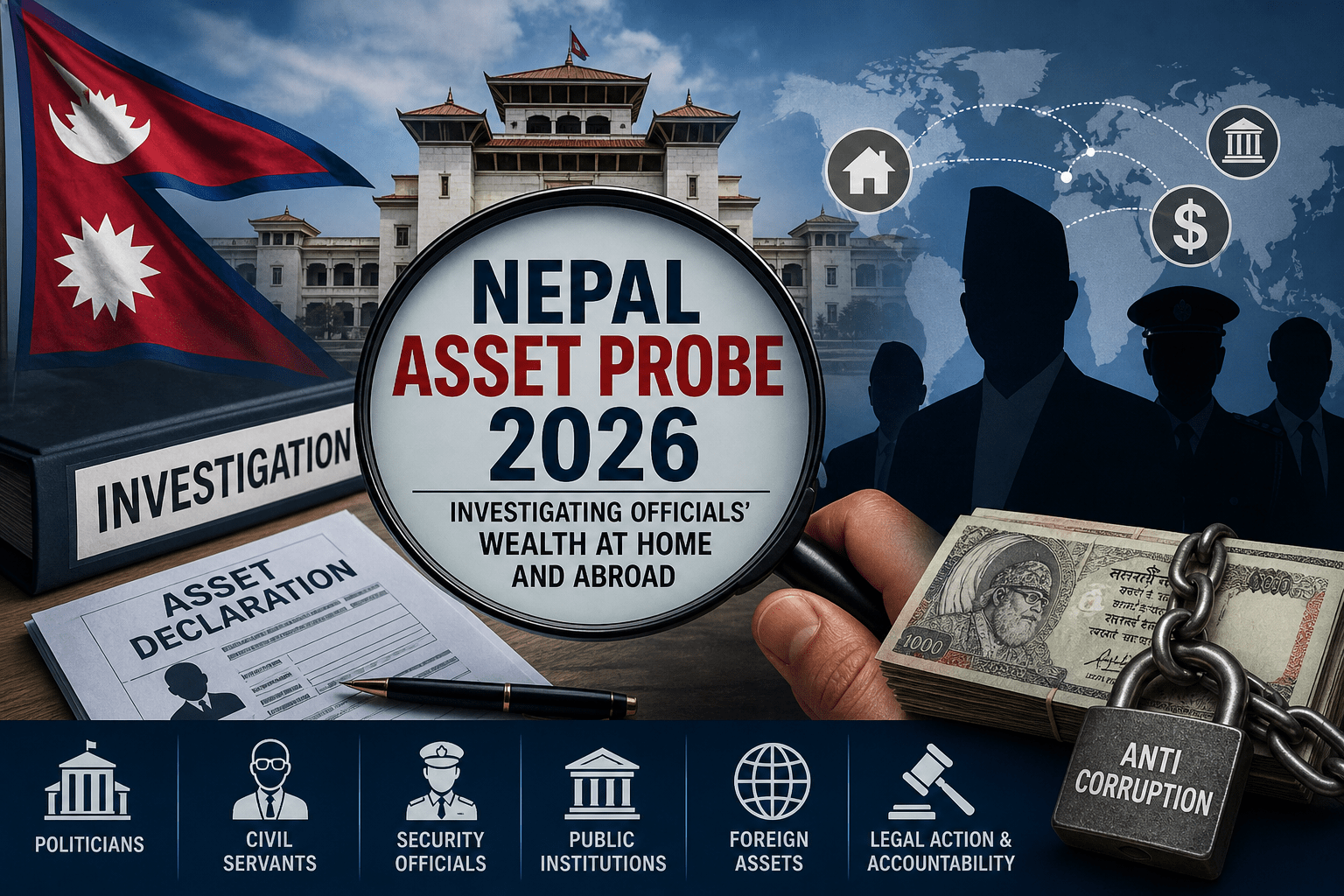
Nepal Asset Probe 2026 to Investigate Officials’ Wealth at Home and Abroad
Nepal has launched a major asset investigation targeting the wealth of public officials accumulated over the past two decades. The newly formed commission will examine the assets of politicians, civil servants, and security officials since 2006. This move is being seen as a strong step toward transparency and accountability in governance.
The probe will not be limited to assets within Nepal. It will also investigate wealth held abroad, making it one of the most comprehensive anti-corruption efforts in recent years. Authorities say this initiative responds to growing public demand for clean governance.
Wide Scope: From Local Leaders to Prime Ministers
The asset probe will cover a wide range of public office holders. This includes individuals from local government positions up to the prime minister. Senior civil servants and security officials are also included in the investigation.
The commission has been authorised to examine first-class government officials and above. It will also include elected representatives at all levels of government. This broad scope ensures that no major office holder is left out.
Who Will Be Investigated?
-
Political Leaders and Ministers
The investigation includes prime ministers, deputy prime ministers, ministers, and provincial leaders. Former members of Parliament and constituent assemblies will also be examined. This ensures accountability across Nepal’s political system.
-
Civil Servants and Security Officials
Senior civil servants, police officers, and intelligence officials will fall under the probe. Retired army officers from colonel rank to former chiefs will also be included. This expands the investigation beyond politicians to administrative and security sectors.
-
Public Institutions and Financial Authorities
Top officials of Nepal Rastra Bank, government-owned banks, and public enterprises will also be scrutinised. University officials and those in government-funded institutions are part of the investigation. This ensures financial transparency across all sectors.
Foreign Assets Also Under Investigation
One of the key features of this Nepal asset probe is its focus on foreign-held wealth. The commission will work with international agencies to trace assets outside the country. This includes coordination with Interpol and Nepali diplomatic missions.
Officials say this step is necessary because illegal wealth is often hidden abroad. By expanding the investigation globally, authorities aim to close loopholes. This could significantly strengthen anti-corruption efforts.
Commission Structure and Leadership
The government formed a five-member commission on April 15, 2026. It is chaired by former Supreme Court justice Rajendra Kumar Bhandari. The team also includes legal, financial, and security experts.
The commission has been given a one-year term to complete its work. It is supported by a team of 38 staff members, including investigators and legal professionals. This structure is designed to handle large-scale investigations efficiently.
Two-Phase Investigation Timeline
The asset probe will be conducted in two phases. In the first phase, the commission will examine assets from 2006 to the present. This period covers major political changes in Nepal.
In the second phase, the investigation will extend back to 1991–2005. This ensures that older cases are not ignored. Authorities aim to build a complete picture of wealth accumulation over time.
Priority Targets in the Investigation
The commission will focus on individuals with a higher risk of corruption. This includes those who have faced complaints or disciplinary action. Officials with wealth beyond their known income sources will also be prioritised.
Special attention will be given to sectors prone to corruption. These include revenue, land administration, and transport. By targeting high-risk areas, the investigation aims to produce meaningful results.
How the Investigation Will Work
The commission has the authority to collect evidence from multiple sources. This includes written documents, oral statements, and digital data. Social media activity can also be examined as part of the investigation.
It can issue public notices asking individuals to submit information within 30 days. Government agencies must respond to requests within 15 days. These measures are designed to ensure smooth and timely investigations.
Legal Action and Accountability
If illegal assets are identified, the commission will prepare detailed reports. These reports will recommend further investigation and legal action. The government must act on these recommendations within 45 days.
Cases may be forwarded to relevant authorities for prosecution. This ensures that findings lead to real consequences. The goal is not just investigation but enforcement.
Concerns from Legal Experts
Some legal experts have raised concerns about the commission’s scope. They warn that it should not conflict with existing institutions. In particular, it must respect the role of the Commission for Investigation of Abuse of Authority.
Experts say the process must follow legal standards and court precedents. Transparency and fairness are essential for credibility. The success of the probe will depend on how it is implemented.
Lessons from Past Investigations
Nepal has conducted similar asset investigations in the past. However, many of them failed to produce results. Reports were often not made public or acted upon.
For example, a major commission formed in 2002 examined thousands of cases. Despite this, its findings were never disclosed. This has led to public skepticism about such initiatives.
A New Push for Transparency in 2026
The current Nepal asset probe 2026 is being seen as a renewed effort to fight corruption. Public demand for accountability has increased in recent years. Citizens are expecting real action this time.
If implemented effectively, the investigation could strengthen trust in government institutions. It could also set a new standard for transparency in Nepal. The coming months will be crucial in determining its success.
Conclusion
The Nepal asset probe targeting officials’ wealth marks a major step toward accountability and anti-corruption. By covering assets both inside and outside the country, the commission has a powerful mandate. However, its success will depend on transparency, fairness, and proper enforcement.
Nepal has seen similar efforts fail in the past, so expectations are high this time. If the government follows through on its promises, this could become a turning point in governance. For now, all eyes are on how effectively the commission delivers results.
Stay updated with the latest Nepal political news and in-depth analysis only on NepInsights.
React to this post
Related Articles